
Vol. 6 No. 1 (2026): ENP Engineering Science Journal
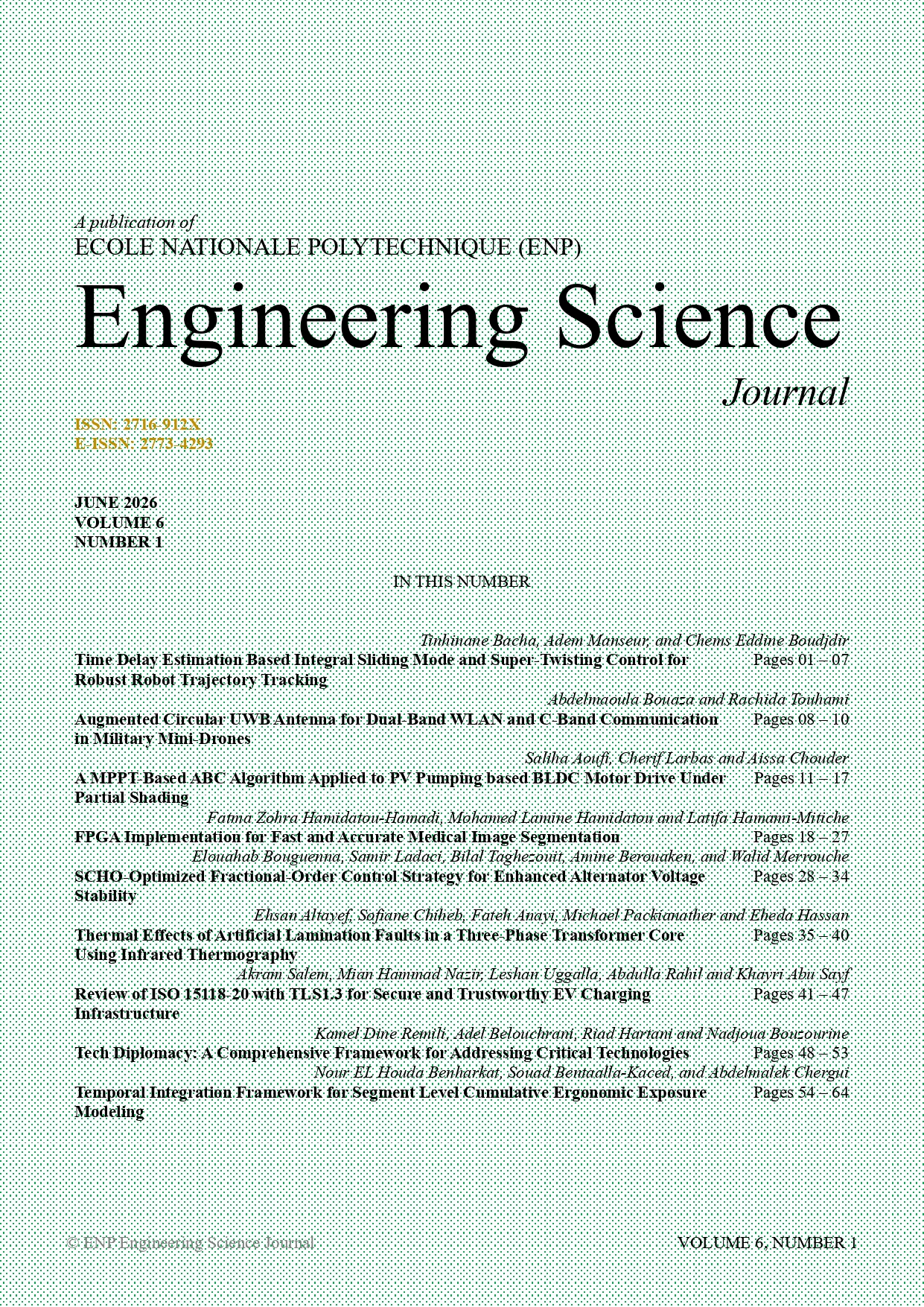
Issue 1 of Volume 6 showcases a vibrant collection of scholarly contributions that reflect the expanding horizons of engineering science and its growing influence on technological innovation and societal development. Bringing together research from diverse disciplines, this issue highlights how modern engineering continues to address complex challenges through interdisciplinary approaches, intelligent systems, and emerging technologies.
A central theme of this issue is the advancement of control and optimization techniques for high-performance engineering applications. Contributions explore robust robot trajectory tracking through time-delay estimation-based integral sliding mode and super-twisting control, enhanced alternator voltage regulation using optimized fractional-order control strategies, and intelligent maximum power point tracking for photovoltaic pumping systems operating under partial shading conditions. These studies demonstrate the ongoing pursuit of efficiency, reliability, and resilience in modern engineering systems.
The issue further highlights innovations in communication, cybersecurity, and digital technologies through the development of an ultra-wideband antenna for military mini-drones, a review of secure electric vehicle charging infrastructures based on ISO 15118-20 and TLS 1.3, and an FPGA-based framework for fast and accurate medical image segmentation. Complementing these advances, research on transformer fault diagnosis using infrared thermography, technology diplomacy for critical technologies, and ergonomic exposure modeling underscores the broad societal and industrial impact of contemporary engineering research.
Together, the contributions in this issue bridge theoretical innovation and practical application, demonstrating the vital role of engineering science in advancing resilient technologies, supporting sustainable development, and addressing the complex challenges of an increasingly interconnected world.


